
Cleanroom Ceiling Panels – Durable, Hygienic & High-Performance Ceiling Solutions for Controlled Environments
- Lucky Deep
- Feb 25
- 2 min read

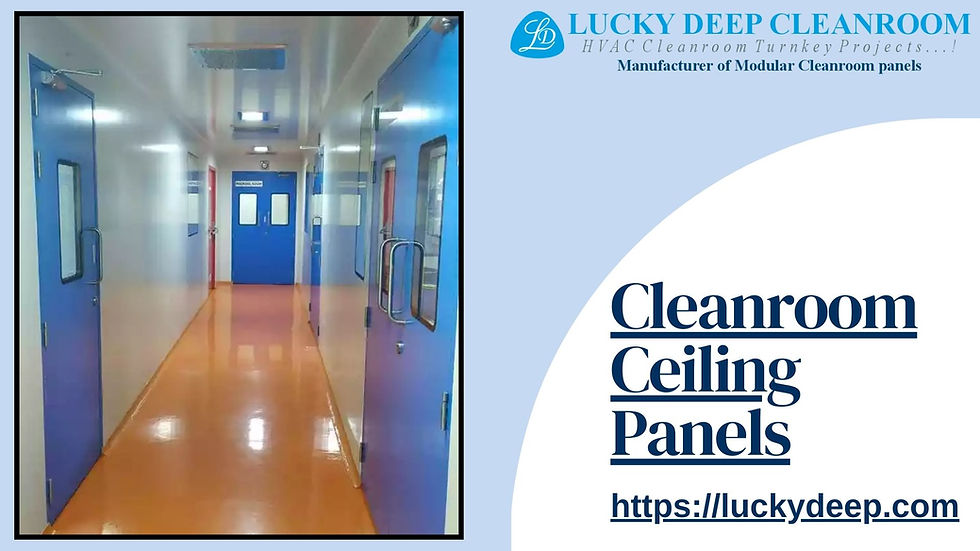
In controlled environments such as pharmaceutical plants, biotechnology labs, healthcare facilities, and electronics manufacturing units, Cleanroom Ceiling Panels play a vital role in maintaining contamination control, structural stability, and long-term durability. Designed to meet stringent industry standards, these ceiling systems ensure a clean, safe, and efficient workspace.
This blog provides a complete overview of Cleanroom Ceiling Panels, including their technical specifications, materials, features, and performance advantages.
What Are Cleanroom Ceiling Panels?
Cleanroom Ceiling Panels are modular ceiling systems designed for walk-on and non-walk-on applications in controlled environments. These panels are engineered to provide:
Structural strength
Air-tight sealing
Thermal insulation
Fire resistance
Hygienic and smooth surface finish
They are typically installed as planks of 1200 mm width, with lengths customized as per project layout drawings.
Technical Specifications of Cleanroom Ceiling Panels
1. Panel Construction
The panels are manufactured using:
Skin Options:
PCGI / PCGI (GPSP)
PPGI / PPGI
Stainless Steel (SS)
Structural Framework:
GI framework
Sheet Thickness Options:
0.5 mm
0.6 mm
0.8 mm
Coating Thickness:
Powder Coating: 60–80 microns
Pre-Coating: 30–35 microns
These construction options ensure corrosion resistance, durability, and a smooth finish suitable for sterile environments.
2. Insulation Options
To enhance thermal efficiency and acoustic performance, different insulation materials are used:
PUF – Density 40 ± 2 kg/m³
PIR – Density 48 ± 2 kg/m³
Rockwool – Density 96 kg/m³ to 144 kg/m³
These insulation cores improve fire resistance, thermal stability, and energy efficiency of the cleanroom.
3. Dimensions & Thickness
Standard Width: 1200 mm
Height/Length: As per project layout
Panel Thickness Options:
35 mm
50 mm
80 mm
100 mm
The flexibility in thickness allows customization based on structural load and insulation requirements.
4. Load Carrying Capacity
Cleanroom Ceiling Panels are designed to withstand loads ranging from:
75 kg to 250 kg per square meter
This makes them suitable for both walk-on and non-walk-on ceiling applications.
5. Sealing & Hygiene
Food-grade silicone sealant applied on both sides
Maximum permissible gap: Not more than 4 mm
This ensures airtight joints and prevents contamination or particle leakage.
6. Support & Hanging System
Supported by wall panels and suspension rods
Hanging arrangement includes adjustable turnbuckles
Anchor fastened securely to the slab
This system ensures structural stability and precise leveling during installation.
7. HVAC & Electrical Cutouts
Provision for HVAC and electrical cutouts is available with:
C-type flashing
This ensures seamless integration of lighting fixtures, diffusers, filters, and other utilities without compromising panel integrity.
8. Color Options
Standard Color: RAL 9002
Custom colors available from RAL chart
The smooth and aesthetically uniform finish enhances the cleanroom’s professional appearance.
9. Panel Types
Progressive Panels
Non-Progressive Panels
Both configurations can be selected depending on the cleanroom design and installation requirements.
Advantages of Cleanroom Ceiling Panels
Modular and quick installation High load-bearing strength Excellent thermal insulation Fire-resistant core options Hygienic and easy-to-clean surfaces Corrosion-resistant finishes Customizable thickness and layout Seamless integration with HVAC and electrical systems
Applications of Cleanroom Ceiling Panels
These panels are widely used in:
Pharmaceutical manufacturing units
Biotechnology laboratories
Healthcare facilities
Electronics manufacturing plants
Food processing industries
Research and development centers
Conclusion
Cleanroom Ceiling Panels are an essential component of any contamination-controlled environment. With robust construction, high load capacity, superior insulation options, and hygienic sealing, they ensure long-term performance and compliance with cleanroom standards.


Comments